4 player games on one phone: what actually works
Four people, one phone on the table, and a few minutes to fill. It sounds like it should not work. A phone screen is about the size of a postcard, and four hands reaching for it is the kind of thing that ends with someone’s drink on the floor.
It does work, but only for a narrow band of games — and the reason that band is narrow is worth understanding, because it also tells you which games to avoid and how to seat people.
Play 1 2 3 4 Player Games
Local offline multiplayer mini games for 1, 2, 3 or 4 players on one device.
The constraint everything else follows from
Four people cannot share a phone screen the way two people can share a board game. Each player can comfortably reach roughly one corner and nothing else. That single fact rules out most of what we normally mean by a multiplayer game.
It means each player needs a fixed region of the screen that belongs to them, and it means their entire interaction has to fit inside that region. One thumb, one target, in one place. As soon as a game asks a player to reach across the middle, or to tap something that moves, the person sitting opposite is at a permanent disadvantage and the game stops being fair.
That is why almost every four-on-one-device game converges on the same shape: a button in each corner and a shared arena in the middle that everyone can see but nobody has to touch.
Why a simple control is a feature
The obvious objection is that one button is not much of a game. In practice a control that simple is the thing that makes the format work at all.
With four people around a table, you cannot explain controls. You have about five seconds of attention before someone starts pressing things. A game where holding the button accelerates and releasing it turns can be learned during the first round by watching what happens — nobody has to be told.
Depth then comes from the situation rather than from the input. Holding down a button is trivial; deciding when to hold it while three other people are trying to shove you off a platform is not. This is the same trick one-button arcade games have used for decades, and it survives the four-player version intact.
What cannot transfer
Three categories reliably fail on a shared screen, and it is worth knowing them before you go looking:
Anything with hidden information. Card games where each player holds a private hand are structurally impossible on one screen. Everyone can see everything. The usual workaround — passing the device around so each player looks in turn — works for two people and collapses with four, because the other three sit and wait.
Anything with long turns. If a turn takes thirty seconds of someone else thinking, three of your four players are doing nothing for ninety seconds at a time. Slow, strictly alternating turn-based games are a two-player format; with four they become a very slow board game with a bad view. Turns survive only when they are short — a single putt — or when the turn itself is worth watching, like someone racing a clock.
Anything requiring precision. Small targets and fiddly gestures assume one person holding the device at a comfortable distance. Four people leaning over a table on a surface that slides around is a different physical situation entirely. A drag can still work, but only when what you drag is big and your whole side of the screen counts as the place to touch.
What is left — simultaneous action, one input each, everything visible — is a genuinely good genre. Racing, sumo-style push-out arenas, tank duels, reaction tests and simple ball games all fit it naturally.
Set the table properly
A few practical things make a noticeable difference:
- Put the device flat on a table. Held in someone’s hand, that person controls the angle, and the other three are playing at a tilt. Flat on a surface is the only neutral arrangement.
- Use a tablet if you have one. This is the single biggest improvement available for four players. A phone works, and four adults on a phone is genuinely cramped. On a tablet everyone gets a real corner.
- Turn the volume up rather than down. Most of these games signal round starts and eliminations with sound, and four people talking over each other will miss a visual cue.
- Agree the format before you start. “First to five”, or best of three across different games. Otherwise you get the argument about whether the last round counted.
- Sit two and two, not all on one side. Opposite pairs reach opposite corners. Everyone crowding one edge means two players are reaching across two others.
Three or four players is the awkward number
Board and card games overwhelmingly assume two or four players. Three is the number that causes design problems, and the reason is kingmaking: when one player clearly cannot win, their remaining choices decide which of the other two does. That is unsatisfying for everyone, including them.
Screen-sharing games sidestep it more easily than board games do, because most of them are simultaneous and scored rather than turn-based and eliminating. If everyone is racing at once, there is no move you can make purely to hurt someone else. It is worth preferring scored formats over elimination formats when you have an odd number of people.
The single-player problem
The format’s real weakness is obvious: it needs other people. An app that only works with a group sits unused most of the time.
The usual answer is bots filling the empty seats, and it is a better answer than it sounds. The difficulty band that matters is narrow — an opponent that never loses is not fun, and one that plays randomly is not either. What you want is something that punishes an actual mistake and otherwise stays out of the way.
Where the app fits
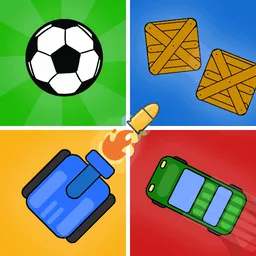
1 2 3 4 Player Games is built around the constraints above: 30 mini games for up to four people at once on one phone or tablet, each player with a fixed corner or side and the same colour in every game. Most of the games follow the shape described here — a control in each player’s corner and a shared arena in the middle — whether that control is a button to hold, a drag or a small stick: Tank Fight, Belly Bump, Car Race, Rail Race, Goal Rush and Pincers among them. A few break the rule on purpose. In Crab Snap and Cash Dash everyone reaches into the middle at once, on a field laid out so that nobody sits closer to the action than anyone else, and the scramble is the point. There are two 2 VS 2 team games, Team Tanks and Capture the Flag, for when there are exactly four of you.
On your own, every game except those two can be played against a bot, on easy, medium or hard, and each game has a short HOW TO PLAY so nobody needs the rules explained. There is nothing to connect to — no account, no lobby, no signal — because everyone playing is already sitting at the same table.
1 2 3 4 Player Games
30 mini games for one to four players on a single device. Simple controls, no account, and nothing to connect to.